AI brain fry: the fatigue your wellbeing strategy can't see
Apex Minds
13 Oct 2026 · 5 min read
Ask most organisations how their people are doing and you'll hear about sickness absence, engagement scores and EAP usage. Those numbers matter. But new research suggests a growing share of the strain on employees doesn't show up in any of them.
A new kind of tired
In March 2026, Harvard Business Review published research from Boston Consulting Group and the University of California, Riverside. They surveyed 1,488 full-time employees at large organisations. 14% reported what the researchers call "AI brain fry": mental fatigue that comes not from AI replacing work, but from constantly supervising it. That means checking outputs, correcting errors, switching between tools and holding it all together.
It isn't burnout in the classic sense. People with AI brain fry are still turning up and still delivering. But underneath, things are slipping:
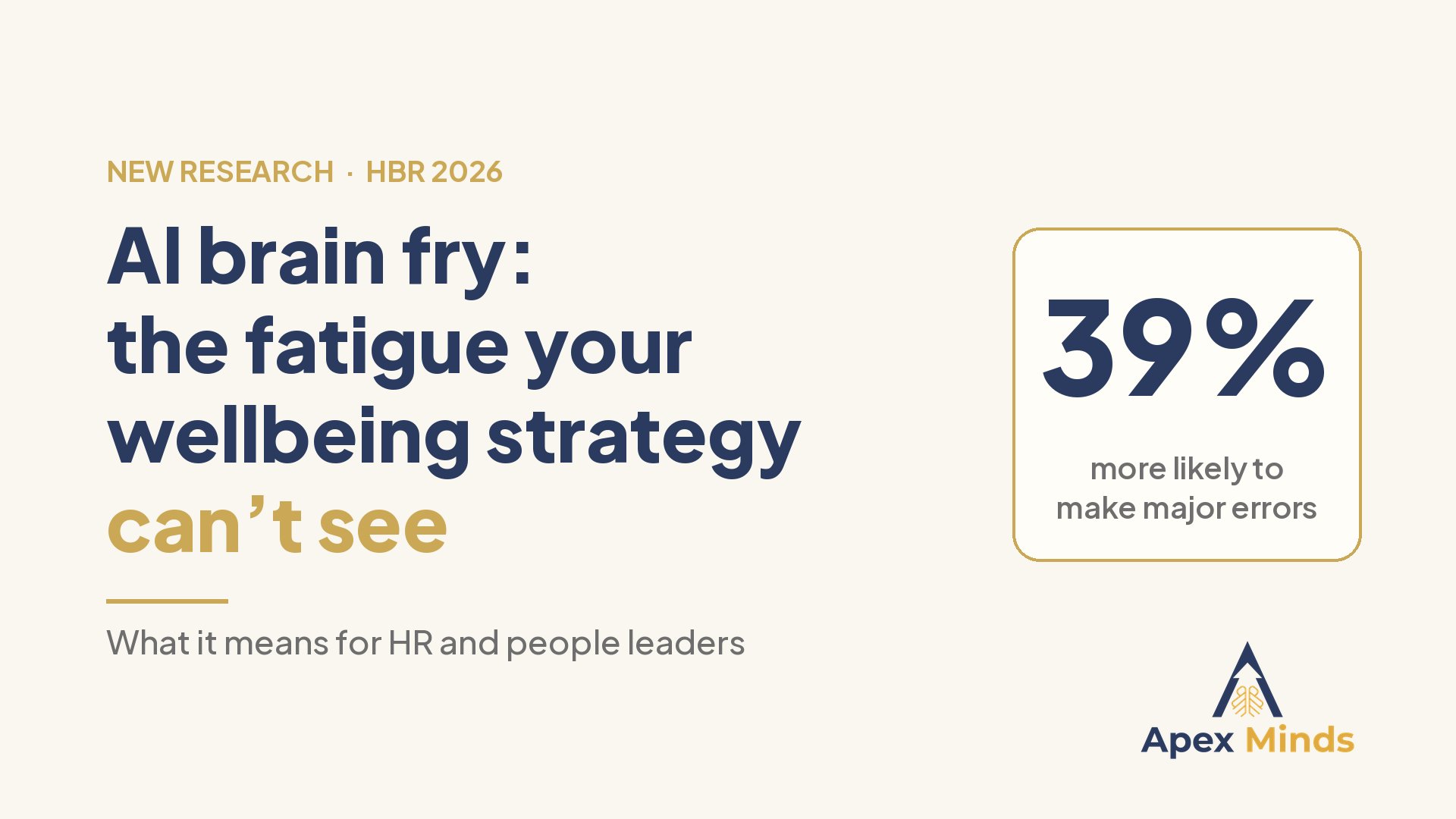
- 39% more likely to make major errors, and 11% more likely to make minor ones
- 14% more mental effort, 12% more mental fatigue and 19% more information overload on tasks that need heavy AI oversight
- Productivity falls once people are juggling three or more AI tools
- 34% are considering quitting, against 25% of their unaffected colleagues
HR is close to the top of the list
One finding should make every people leader pause. 19.3% of HR professionals reported AI brain fry, second only to marketing at 25.9%. The teams responsible for everyone else's wellbeing are among the most exposed.
The UK picture is heading the same way
This sits on top of a wider trend. The CIPD/Simplyhealth Health and Wellbeing at Work report puts average UK absence at 9.4 days per employee a year, up from 5.8 in 2022. Mental ill health is now the leading cause of long-term absence.
Employers are responding. 57% now have a stand-alone wellbeing strategy, and three-quarters of senior leaders have wellbeing on their agenda. But one statistic stands out: 64% of organisations take steps to reduce stress, yet only half believe those steps work.
Why the usual approach misses it
Most workplace wellbeing support is built to respond to a problem once it's visible: an EAP call, a sick note, a conversation with a manager when someone is clearly struggling. AI brain fry, like most performance pressure, happens much earlier and much more quietly.
By the time it shows up in absence data, the cost has already been paid in slower decisions, avoidable mistakes, lost deep work and good people losing their edge.
Treat mental performance as a skill, not a symptom
Elite sport worked this out a long time ago. Athletes don't wait until they break down to work on focus, recovery and handling pressure. They train those capacities deliberately, as part of performing well.
The same thinking applies at work, especially now that so many roles involve hours of high-stakes cognitive oversight. Some practical starting points for HR and people leaders:
- 1Audit the tool load. The research points to three or more AI tools as a tipping point. Where can teams consolidate?
- 2Protect focus time. Supervising AI is demanding, deep work. Treat it like that, not as something squeezed between meetings.
- 3Build recovery into the working day. Short, deliberate resets beat waiting for the weekend.
- 4Ask different questions. Alongside "how are you feeling?", try "where is your thinking getting stretched right now?"
- 5Start before the crisis. Make mental performance training part of how your organisation develops people, not just how it supports them when things go wrong.
The bottom line
AI is changing what work demands of our minds faster than most wellbeing strategies are adapting. The organisations that thrive will be the ones that see the pressure early and build their people's capacity to handle it.
Where are your teams running on empty right now, and would you know if they were?
Apex Minds helps organisations build mental performance proactively, so their people can sustain their best work under pressure. Get in touch
Also published on LinkedIn.
Sources: Bedard et al., Harvard Business Review study (summary), March 2026 (BCG & UC Riverside); CIPD/Simplyhealth, Health and Wellbeing at Work 2025.
More articles
53%
of UK organisations have a stand-alone wellbeing strategy (CIPD, 2023)
Employee wellbeing software vs performance programmes: what each actually measures
13 Nov 2026 · 6 min read
67%
of leaders recognise L&D's impact, down from 81% in 2021
How to measure the ROI of training (and prove it to your board)
10 Nov 2026 · 7 min read
5–25 min
programmes that fit the working day
Resilience training for employees that lasts beyond the workshop
6 Nov 2026 · 5 min read